Rigging & Lifting, Safety & Compliance, Technical Guides
Screw Pin vs Bolt Type Shackle: Which One Should You Use?
Aug
If you work anywhere near a crane, a spreader beam, or a rigging yard, you’ve handled a shackle more times than you can count. It’s one of the simplest pieces of lifting hardware there is — a U-shaped body and a pin. But that simplicity hides an important decision: which pin type do you actually need?
Get it wrong, and you’re not just risking a failed lift — you’re risking a dropped load. Get it right, and you’ve built a connection that’s both safe and appropriate for the job. Here’s how to tell the difference between a screw pin shackle and a bolt nut cotter shackle, and when to use each one.
The Core Difference: Temporary vs Permanent
According to Miguel Cohn, Western Regional VP of Sales at The Crosby Group, in Crosby’s “Ask the Expert” series, the distinction comes down to one simple rule: screw pin shackles are for temporary applications, and bolt nut cotter shackles are for long-term or permanent connections.
That single line explains almost everything you need to know about choosing between the two — but let’s unpack why it matters.
Screw Pin Shackles: Fast, Simple, Temporary
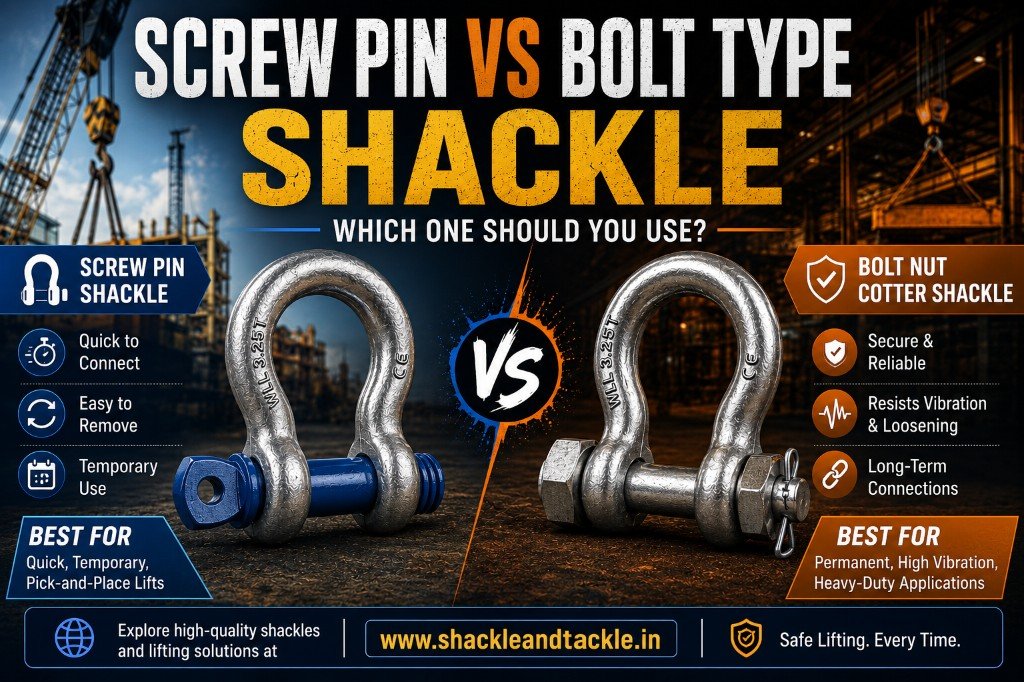
A screw pin shackle has a threaded pin that screws directly into one ear of the shackle body. No separate nut, no cotter pin — just thread it in, hand-tighten (or use a spud wrench), and you’re rigged. That’s exactly why riggers reach for them constantly: they’re quick to connect and just as quick to disconnect, whether they’re paired with a sling hook or run straight off a length of wire rope.
Industry guidance is consistent on this point — screw pin shackles are ideal for temporary applications or “pick-and-place” lifts where the shackle is frequently removed and reused, precisely because they’re so quick to connect and disconnect.
Good screw pin use cases:
- Rigging that gets set up and broken down repeatedly through the day
- Pick-and-place lifts (like moving pipes, beams, or crates from one spot to another) using eye bolts or lifting clamps for attachment points
- Static or short-duration lifts with minimal vibration
- Construction sites and equipment moves where speed matters
The catch? A threaded pin can back itself out over time, especially if it’s exposed to vibration, rotation, or repeated shock loading. That’s not a flaw — it’s simply outside what a screw pin is designed for.
Bolt Nut Cotter Shackles: Built to Stay Put
A bolt type shackle — also called a “safety shackle” — replaces the threaded pin with a smooth bolt that passes through both ears, secured by a nut on one end and locked in place with a cotter pin (split pin). Nothing about this connection relies on threads holding tension against vibration.
This is why bolt nut cotter shackles are the standard choice anywhere the load will stay rigged for an extended period, or where the connection experiences ongoing movement. As Cohn explains in the Crosby video, shackles used in permanent connections — like those linking a load to a spreader beam that gets worked throughout the day — must be the bolt nut and cotter type. The reason is dynamic loading: repeated vibration can slowly work a screw pin loose, creating the risk that it backs itself out entirely and releases the load. The nut and cotter pin on a bolt type shackle exist specifically to stop that from happening.
Good bolt nut cotter use cases:
- Permanent or semi-permanent rigging (spreader beams, fixed wire rope slings, structural connections)
- Applications with regular vibration or dynamic loading — common with chain pulley blocks and electric hoists running continuous cycles
- Overhead lifting where the load could shift or slide on the pin
- Marine environments, long-haul transport, and any setup where the shackle won’t be inspected between every cycle
Why the Pin Type Actually Matters
It’s tempting to treat this as a minor spec detail, but the mechanics are straightforward: a screw pin holds by friction and thread engagement, while a bolt-nut-cotter assembly holds by mechanical lock. Under constant motion, friction can slowly lose its grip — a nut secured with a split cotter pin cannot.
That’s also why Cohn’s advice comes with a firm follow-up: if you’re using a bolt nut and cotter shackle in a permanent application, always fit the cotter pin. Skipping it defeats the entire purpose of choosing that shackle type in the first place — the nut alone can still work loose without the pin locking it in place.
Quick Reference: Screw Pin vs Bolt Type
| Factor | Screw Pin Shackle | Bolt Nut Cotter Shackle |
|---|---|---|
| Best for | Temporary, frequent connect/disconnect | Permanent or long-term rigging |
| Vibration resistance | Lower — pin can back out over time | High — mechanically locked |
| Setup speed | Fast | Slightly slower (needs nut + cotter pin) |
| Typical use | Pick-and-place lifts, short-term rigging | Spreader beams, fixed slings, dynamic loads |
| Inspection needs | Check pin engagement before every lift | Verify cotter pin is fitted and intact |
Choosing the Right Shackle for Your Job
Before you pick a shackle, ask yourself two questions:
1. How long will this stay rigged? A few hours or one lift cycle → screw pin. Days, weeks, or permanently → bolt type. 2. Will it see vibration or repeated motion? Any dynamic loading, machinery vibration, or road transport → go bolt nut cotter, even if the connection is technically “temporary.”
Whichever type you land on, always match it to the correct working load limit (WLL) for your application, and never mix shackle grades or sizes across a rigging set. Pair it correctly with the rest of your rigging system too — a shackle is only as reliable as the hook, turnbuckle, or lifting clamp it’s connected to. If you’re unsure which grade or size suits your load, it’s worth checking size charts against the actual working load before ordering.
At Shackle & Tackle Mart, we stock both screw pin and bolt type D-shackles and bow shackles in a range of capacities — including our Dee Shackle line — with GST invoicing and pan-India dispatch on every order. If you’re speccing shackles for an ongoing project or need bulk pricing, you can browse the full lifting tools catalogue or request a bulk quote and our team will help you match the right shackle type to your application.
The Bottom Line
Screw pin and bolt nut cotter shackles aren’t interchangeable — they’re built for two different jobs. Screw pins earn their place through speed and convenience in temporary rigging. Bolt nut cotter shackles earn theirs through mechanical security in permanent, vibration-prone connections. Choosing correctly isn’t just about following procedure — it’s the difference between a shackle that holds and one that quietly works itself loose.
When in doubt, remember the rule straight from the rigging floor: if it’s staying up, bolt it, nut it, and cotter-pin it.
Looking to stock up on rigging hardware? Explore our full range of shackles, wire rope slings, and lifting equipment at shackleandtackle.in, or get in touch for bulk industrial pricing.
Related guides
Source lifting gear with confidence
380+ industrial products · GST invoicing · Pan-India dispatch · Project & tender pricing
Browse full catalogue ·
Request bulk quote ·
WhatsApp +91 85888 10825
