Rigging & Lifting, Safety & Compliance, Technical Guides
What Is a Shackle? Types, Parts, and Materials Explained
Aug
A shackle looks simple enough — a curved piece of metal with a removable pin. But it’s one of the most-used connectors in rigging for a reason: it’s the component that joins two other pieces of hardware together. A classic example is connecting a turnbuckle to an eye bolt fixed to a post — the shackle is what sits in between and links them.
Get familiar with the parts, materials, and types below, and picking the right shackle for a job stops being guesswork.
The Three Parts of a Shackle
- Bow — the curved, U-shaped body of the shackle that carries the load.
- Pin — the removable piece that closes the shackle, used to attach and detach it from rigging components.
- Ears — the two ends of the bow that the pin passes through. On a screw pin shackle, one ear is threaded and the other isn’t, which is how the pin locks in.
Shackle Materials and Coatings: Which One Fits Your Environment
The coating or material a shackle is made from matters as much as its shape — it’s largely dictated by where and how the shackle will be used.
- Hot-dip galvanized — the most common finish, suited to general-purpose applications. It holds up well in typical industrial and construction settings, but doesn’t offer the same corrosion resistance as stainless steel around salt water or coastal environments.
- Powder-coated galvanized — a step up from standard hot-dip galvanizing, adding an extra layer of durability and corrosion resistance over the shackle’s working life.
- Stainless steel — hard to beat for corrosion resistance, especially in salt water or marine environments. Keep in mind “stainless” doesn’t mean rust-proof — occasional washing with fresh water or a stainless steel cleaner keeps it performing well. The trade-off is strength: stainless steel shackles are generally not as strong as an equivalent carbon or alloy steel shackle, so always check the WLL rather than assuming.
Shackle Types: Bow, Anchor, D (Chain), and Specialty
Bow and anchor shackles
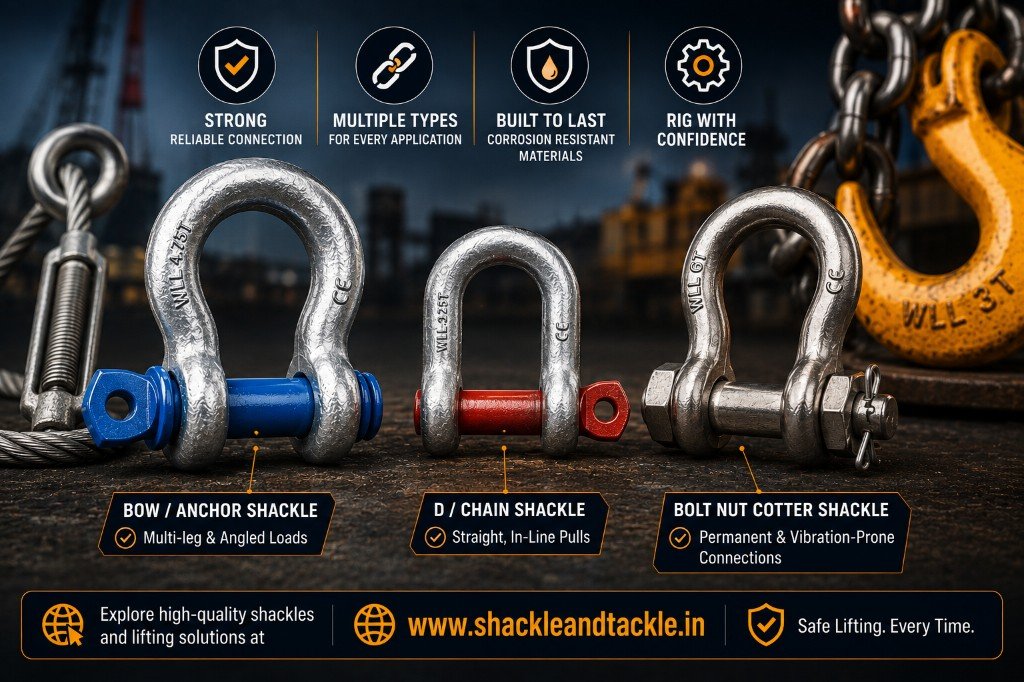
These two terms are often used interchangeably, and the main difference between them comes down to bow width — an anchor shackle has a slightly slimmer bow, while a bow shackle‘s body is noticeably wider. That extra width lets a bow/anchor shackle accept multiple sling legs or fittings side by side and tolerate some side loading, though manufacturer guidance typically calls for a reduced WLL as the load angle moves away from straight in-line — commonly around a 30% reduction at 45° and up to 50% at 90°.
D or chain shackles
Named for the “D” shape their body makes, dee shackles are narrower and straighter than bow shackles. That narrower geometry is exactly what makes a D-shackle ideal for straight in-line loading and pulling — think connecting a chain to an eye bolt or anchor point. D-shackles are not designed for side loading; forcing an angled pull on one can bend the pin or distort the body. A common starting size on maintenance jobs is a dee shackle 1 ton.
Specialty shackles
Beyond the standard bow and D types, there are purpose-built variants like snap shackles, used mainly in marine and sailing applications for quick-release connections. If your rigging setup has an unusual requirement, it’s worth checking whether a specialty shackle exists for it before improvising with a standard one.
Bow vs D-Shackle: Quick Comparison
| Factor | Bow / Anchor Shackle | D (Chain) Shackle |
|---|---|---|
| Body shape | Wide, rounded bow | Narrow D profile |
| Best for | Multi-leg slings, slight angularity | Straight in-line pulls |
| Side loading | Tolerated with WLL de-rating | Not recommended |
| Typical pairing | Spreader beams, bridles | Chain to eye bolt, inline rigging |
| Pin types | Screw pin or bolt-nut-cotter | Screw pin or bolt-nut-cotter |
For pin selection, see our guide on screw pin vs bolt type shackles.
Choosing the Right Shackle
1. Match the shackle to the load direction. Straight pull → D-shackle. Angled or multi-leg connection → bow/anchor shackle. 2. Check the Working Load Limit (WLL). It should meet or exceed the WLL of the other rigging hardware in the assembly, such as your hooks and lifting clamps. 3. Pick the right material for the environment. General industrial use → hot-dip galvanized. Long-term outdoor or higher-durability needs → powder-coated galvanized. Marine or corrosive environments → stainless steel. 4. Confirm the pin type suits the application. Screw pin for temporary, frequent connect/disconnect work; bolt-nut-cotter for permanent or vibration-prone connections.
Building Out Your Rigging Set
A shackle rarely works alone — it’s usually the connector between an eye bolt, a turnbuckle, a hook, or a length of wire rope or chain. Getting the shackle type and material right is what keeps the rest of that chain of hardware working as intended.
At Shackle & Tackle Mart, we stock bow, anchor, and D-shackles across multiple sizes and finishes, along with the eye bolts, turnbuckles, and hooks they’re commonly paired with — all with GST invoicing and pan-India dispatch. Browse the full shackles range or request a bulk quote if you’re speccing hardware for an ongoing project.
The Bottom Line
Shape, pin type, and material each answer a different question: shape decides how the load can be applied, pin type decides how long the connection will stay rigged, and material decides how well it’ll hold up in your environment. Get all three right, and the shackle stops being the thing you have to think about — which is exactly what you want from a connector.
Explore bow shackles, dee shackles, and lifting tools at shackleandtackle.in, or contact us for bulk pricing.
Related guides
Source lifting gear with confidence
380+ industrial products · GST invoicing · Pan-India dispatch · Project & tender pricing
Browse full catalogue ·
Request bulk quote ·
WhatsApp +91 85888 10825
