
Rigging & Lifting, Safety & Compliance, Technical Guides
Chain Sling & Lifting Chain Maintenance: The Complete Care Guide
Aug
A lifting chain is one of the toughest connections you’ll ever rig. Used on a chain pulley block, it shrugs off abrasion, heat, and rough site conditions that would shred a wire rope sling or web sling in a single lift. But “tough” doesn’t mean “maintenance-free.” Neglect a chain sling long enough, and it quietly becomes the weakest link in your rigging setup — sometimes literally.
Here’s a practical, no-nonsense guide to keeping your lifting chains safe, compliant, and working the way they’re supposed to.
Why Chain Sling Maintenance Isn’t Optional
Alloy chain slings are built to last — with proper care, a well-made chain sling can serve for 20 to 30 years. But wear accumulates every single time a chain rubs, bends, or gets loaded near capacity, and most of that wear is invisible to the naked eye until it’s already a safety problem.
That’s why standards like OSHA, ASME B30.9, and LOLER require documented periodic inspections for chain slings — maintenance isn’t a courtesy, it’s what keeps a chain’s rated Working Load Limit (WLL) actually valid between formal examinations.
Daily Do’s for Chain Sling Care
1. Inspect before every single lift. Check the identification tag for legibility (size, grade, and WLL should be clearly readable), and look over each link for cracks, bends, gouges, or elongation before you rig anything to it.
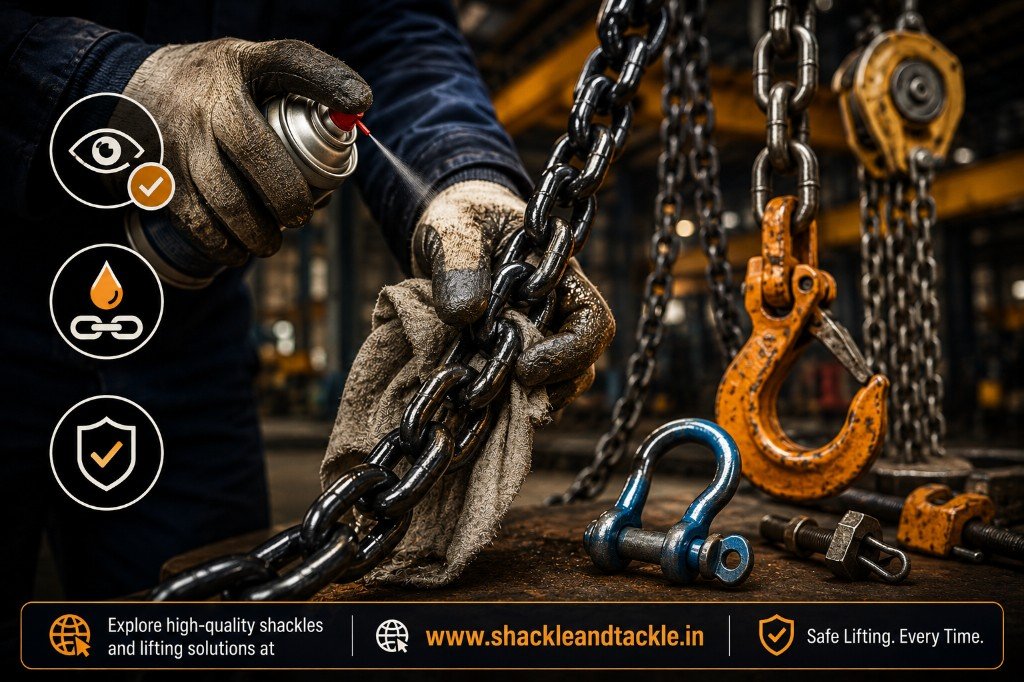
2. Clean the chain before you inspect it. A chain coated in paint, grease, or dirt can hide nicks, gouges, and other damage that a quick glance would otherwise catch.
3. Lubricate regularly — but don’t overdo it. Apply a light lubricant on a routine schedule to prevent internal link friction and rust, but avoid over-lubrication, which just attracts dust and dirt and defeats the purpose. A spray-type lubricant works best since it penetrates between the plates and around the pins.
4. Lubricate the hook and pivot pin too. Whenever you’re using hooks or self-locking hooks with your chain sling, apply lubricant to the hook shank thread and pivot pin at every pre-use check — a dry pivot pin can cause the latch mechanism to bind under load and fail to engage properly.
5. Store it hanging, dry, and ventilated. Hang chains on racks or dedicated hooks rather than leaving them coiled on the ground or in damp corners of the yard. This prevents tangling, kinks, and — most importantly — corrosion.
6. Use the correct grade for the job. Only alloy steel chain — Grade 80 or Grade 100 — is rated for overhead lifting. Chain bought off a hardware store shelf is not manufactured or certified for lifting duty, no matter how strong it looks.
Don’ts That Shorten a Chain’s Life (or Worse)
- Don’t drag the chain along the ground. It causes gouges and abrasion that weaken individual links from the outside in.
- Don’t expose the chain to acids or aggressive chemicals. Corrosion and pitting from chemical exposure can silently eat away at load-bearing cross-section.
- Don’t load beyond the rated WLL. Alloy steel chain will visibly stretch when overloaded — which is actually a useful early warning sign, unlike other steel types that can snap without any warning at all.
- Don’t improvise repairs. Makeshift links, welded fixes, or non-standard fasteners have no place in a lifting chain. Repairs should only be done by the manufacturer or a qualified, competent person.
- Don’t ignore the fittings attached to the chain. Check connected shackles, master links, and hooks for deformation, cracking, or corrosion at the same time you inspect the chain itself — a rigging set is only as strong as its weakest fitting.
Know When to Retire a Chain
Wear happens gradually, so it helps to know the numbers. Industry inspection data shows that a chain in continuous industrial use can lose roughly 0.1–0.3 mm of link diameter for every 500 operating hours under normal loading. A 10 mm link worn down to 9 mm has already lost close to a fifth of its original cross-sectional area — well past the point where it should stay in service.
As a general rule: retire the chain once elongation crosses about 2–3% of its original length, and remove it from service immediately if you spot heat damage, weld spatter, bent or twisted links, pitting, or corrosion. When in doubt, don’t guess — get it checked by a qualified person.
Inspection Frequency: What’s Actually Required
| Type | When | Who |
|---|---|---|
| Pre-use inspection | Before every lift | Person using the sling |
| Periodic inspection | Monthly/quarterly (severe service) or annually (normal) | Trained competent person |
| Documented inspection | All periodic checks recorded | Designated competent person |
Building a Reliable Rigging Set
A chain sling doesn’t work in isolation — it’s part of a system. Pairing a well-maintained chain with a properly rated chain pulley block, the right shackle, and a compatible hook is what actually keeps a lift safe from end to end. If your rigging also involves wire rope slings, the same core principles apply — keep it clean, lubricated, dry, and within its rated capacity.
At Shackle & Tackle Mart, we stock chain pulley blocks, shackles, hooks, and wire rope & accessories with GST invoicing and pan-India dispatch. If you’re setting up a rigging system for an ongoing project, you can browse our full lifting equipment catalogue or request a bulk quote — our team can help you match the right chain grade and hardware to your load.
The Bottom Line
A lifting chain’s biggest advantage — its raw durability — is exactly what makes it easy to neglect. It won’t fray like a rope or tear like a strap; it’ll just quietly wear down until it doesn’t. A five-minute pre-use check, a light coat of lubricant, and dry, hanging storage are small habits that keep a chain sling doing its job safely for years, instead of failing without warning on the one day it matters most.
Need rigging hardware? Explore chain pulley blocks, shackles, and lifting tools at shackleandtackle.in, or get in touch for bulk industrial pricing.
Related guides
Source lifting gear with confidence
380+ industrial products · GST invoicing · Pan-India dispatch · Project & tender pricing
Browse full catalogue ·
Request bulk quote ·
WhatsApp +91 85888 10825
